The Ugly Side of Wellness in Australia: What Nobody Wants to Talk About

Updated: Jun 4

For an industry built on the foundations of health, healing and helping people, there is an uncomfortable reality that many clinicians, clinic owners and healthcare professionals experience behind the scenes.
I have spent 23 years in the wellness space as a Strength & Conditioning Professional Coach and as a Qualified Nutritionist. I am also an Australian & World Fitness Champion, I turned Pro in 2005 and have coached over 2500 women in areas of weight loss, peri-menopause and to compete in local, national and world stage competitions. I have watched this space change for over 2 decades!
The wellness industry in Australia is booming. Medical weight loss, peptides, IV vitamin therapy, longevity medicine, biohacking, functional health and preventative healthcare have all experienced unprecedented growth over recent years.
Yet beneath the polished social media posts, luxury clinics and influencer marketing lies a side of the industry that many professionals quietly discuss but few are willing to publicly address.
This is not an attack on wellness. In fact, quite the opposite. It's about those people who have become wellness "politicians" who want money and power.
Those of us who genuinely believe in the future of preventative healthcare have a responsibility to acknowledge the challenges threatening the integrity of the industry. How do I have the authority to even speak on this? Did I mention that I have spent 2 decades on the frontline in Paramedicine? A registered medical professional. I wanted to help people and 20 years later, this remains my position, to help, share and collaborate. Read on... it's scathing.
1. Competition Has Become More Aggressive Than Collaborative
Healthcare should never be a race to the bottom.
Yet many clinicians entering the wellness space quickly discover that competition can be fierce.
Rather than focusing on patient outcomes, education and clinical excellence, some businesses spend considerable time attacking competitors, criticising other practitioners and attempting to undermine established businesses. Making vexacious and false complaints to AHPRA, TGA and the HCCC, it's crazy!
Instead of asking:
"How can we improve patient care?"
The conversation becomes:
"How can we take market share?" This blows my mind because EVERY human deserves to be able to make decisions about their own health care.
The result is an environment where collaboration is replaced by distrust and where healthcare professionals become reluctant to share knowledge for fear it will be used against them.
The irony is that Australia is a large country with enormous demand for quality preventative healthcare.
There is room for everyone who operates ethically and professionally.
2. Social Media Has Become More Powerful Than Clinical Evidence
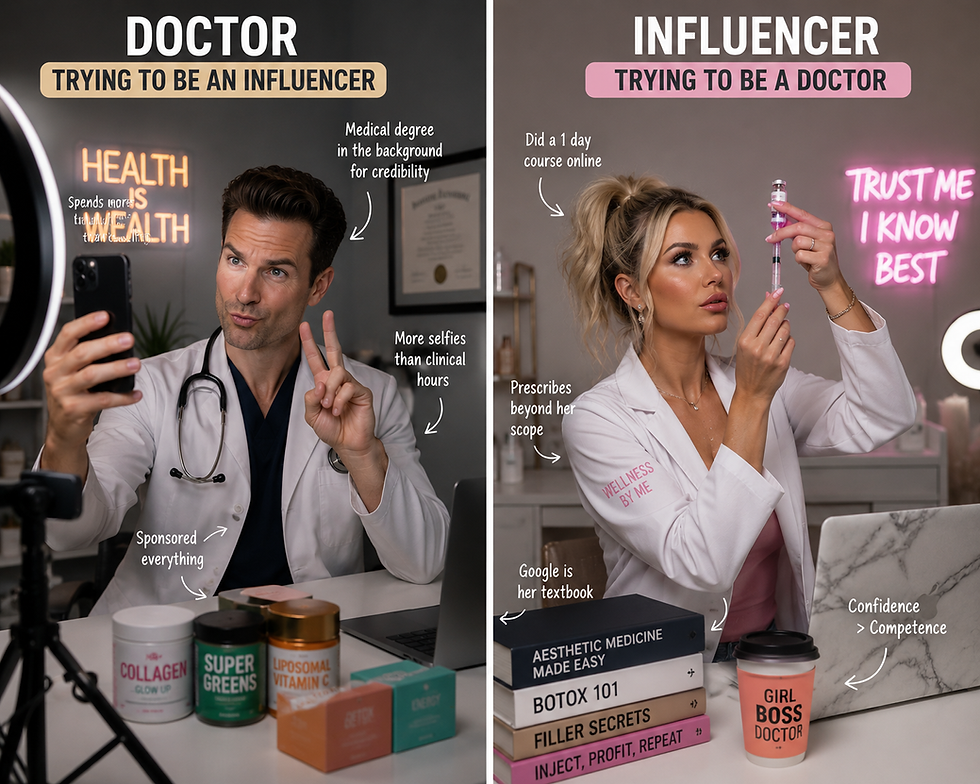
One of the most concerning trends is the rise of social media experts with little or no formal healthcare training.
Many Australians now receive their health information from:
Influencers who are approximately 21 years old giving advice on peptides and GLP-1's - this is just insane
Fitness personalities
Online coaches
Biohackers
Content creators
rather than qualified healthcare professionals.
Complex medical topics are often reduced to:
30-second videos
Viral reels
Clickbait headlines
Unverified claims
Doctors are trying to be influencers & influencers are trying to be Doctors
This creates unrealistic expectations and can place clinicians in difficult positions when patients arrive requesting treatments based on information they have seen online.
Medicine should be driven by evidence, not engagement metrics.
3. Advertising Rules Exist – But Many Ignore Them
Australia has some of the strictest healthcare advertising regulations in the world.
The Therapeutic Goods Administration (TGA) and AHPRA provide clear guidance regarding the advertising of prescription-only medicines and regulated health services.
Yet anyone spending a few minutes on social media can observe examples of businesses openly promoting:
Prescription medications
Compounded medicines
Peptides - one Perth clinic offers Retatrutide, you can just buy it from them and they advertise it! Why are they still operating?
Injectable therapies
Medical weight loss drugs
Therapeutic claims unsupported by evidence
Many clinicians who carefully follow the rules are left wondering why some businesses appear willing to take significant risks for marketing purposes.
Many clinicians who have trained with an Academy that may be based in Sydney are being told by the owner, who mind you is a pharmaceutical salesperson, NOT a registered medical professional, "Just advertise NAD & Glutathione until you get a warning letter from AHPRA, then take it down" - WHY is this Academy still operating?
This Academy is also operating with a pharmacy where clinicians will often receive random vitamins in unknown patient names just so they have stock. THIS is disgusting behavior and dangerous.
This also creates an uneven, totally illegal playing field.
The businesses investing heavily in compliance often find themselves competing against businesses that are willing to ignore the regulations entirely.
4. Compliance Often Feels Like a Competitive Disadvantage
Many clinic owners report feeling frustrated by the reality that strict compliance can be expensive.
Compliance requires:
Proper governance - We provide this
Clinical oversight - Our Doctors provide this
Training - We provide this along with our Doctors and Clinicians
Documentation - We provide templates
Consent processes - We provide templates
Ongoing education - We provide this weekly
Professional indemnity - We guide you on this
Legal advice - We can provide a Legal entity for you
All of these measures take time and money.
Meanwhile, businesses operating outside best-practice frameworks may appear more profitable in the short term because they avoid these costs. They are racing to the bottom. DON'T sacrifice your registration or your business, ever!
The challenge is that patients rarely see the systems operating behind the scenes.
They see the price. Not the governance.

5. Regulatory Enforcement Is Often Perceived as Inconsistent
A common concern raised across the industry is the perception that enforcement can be inconsistent. It's not perception, it's real. While we do not know the backend on how they monitor and regulate, we know that their are clinicians and clinics out there who don't give a toss about the regulations or they are so green to our industry that they have no idea and the shitty place they learned from did not advise them.
Did the the wellness industry blow up so fast that the regulartory bodies are not able to keep up?
Many healthcare professionals report seeing examples of questionable advertising, clinical practices or social media content that appear to remain publicly available for extended periods.
Whether this is due to:
Resource limitations
Investigation processes
Jurisdictional complexity
Evidentiary requirements
or other factors, the perception among many clinicians is that enforcement struggles to keep pace with the rapid growth of the wellness industry.
This can create frustration among businesses that invest heavily in compliance while watching others seemingly operate without consequence.
6. Fear Is Growing Among Clinicians, especially Aesthetic Nurses
Recent regulatory changes have created uncertainty for many Queensland nurses working within wellness and aesthetic medicine.
Queensland has become a focal point for concerns surrounding medicines governance within the wellness sector. However, the underlying issues relating to medicine possession, storage, prescribing relationships and clinical governance exist across all Australian jurisdictions. Many clinicians are now reassessing their business models to ensure they remain compliant with evolving regulatory expectations
Questions surrounding:
Possession of medicines
Storage requirements
Supply arrangements
Prescriber relationships
Clinical governance
have left many practitioners seeking clarity.
For some nurses, the concern is not merely compliance.
It is fear. Fear of unintentionally breaching legislation. Fear of regulatory action.
Fear of operating in a space where the rules can be difficult to interpret and where misinformation spreads rapidly through social media groups and online forums.
The result is that many excellent clinicians are choosing to step back from services they are fully capable of providing because they are unsure where the legal boundaries lie.
New South Wales
Governed by:
Poisons and Therapeutic Goods Act 1966
Poisons and Therapeutic Goods Regulation 2008
NSW has similar requirements regarding:
Lawful possession of medicines
Storage and security
Authority to administer medicines
Prescriber responsibility
Record keeping
Many wellness clinics operating under "clinic stock" models may face challenges if scrutinised.
Victoria
Governed by:
Drugs, Poisons and Controlled Substances Act 1981
Drugs, Poisons and Controlled Substances Regulations 2017
Victoria places significant emphasis on:
Authorised possession
Storage and transport
Prescriber accountability
Documentation
There are similar concerns regarding compounded medicines, peptides and weight loss medications.
Western Australia
Governed by:
Medicines and Poisons Act 2014
WA has some of Australia's strictest requirements for:
Nurse-administered medicines
Authorised practitioners
Cosmetic and wellness treatments
Storage and possession
Many aesthetic nurses in WA are already very familiar with these restrictions.
South Australia
Governed by:
Controlled Substances Act 1984
SA has requirements around:
Supply
Administration
Storage
Prescribing relationships
Although less discussed publicly, the expectations are very similar.
Tasmania
Governed by:
Poisons Act 1971
Requirements mirror other jurisdictions regarding:
Authorised possession
Storage
Administration authority
Record keeping
ACT and Northern Territory
Both have medicines and poisons legislation broadly aligned with the national framework.
Clinicians are expected to demonstrate:
Appropriate prescribing relationships
Governance
Secure storage
Lawful possession
The Bigger Issue
The real issue is not Queensland itself.
The bigger issue is that many wellness clinics across Australia were built during a period where:
Regulations were poorly understood
Guidance was inconsistent
Social media "experts" became educators
Compliance often took a back seat to growth
As regulators increasingly focus on:
Medical weight loss
Peptides (not enough focus on this!)
IV therapy
Cosmetic injectables
Compounded medicines
all states are likely to see greater scrutiny.
The current estimate of IV Therapy, Wellness and Longevity Clinics by state

NSW, QLD & VIC are likely to account for over 85% of Australia's Wellness & IV Therapy Market.
7. The Rise of the "Weekend Expert"
Another challenge is the growing number of short, low-quality educational programs entering the market. There are so many and we strive to remain the highest quality, safest choice for all of our affiliates. Your registration is so important to us and patient dafety is paramount.
Healthcare is complex.
Competency cannot be achieved through a few hours of online content alone, ever.
Yet some practitioners are entering highly specialised areas with limited education, minimal mentoring and little understanding of the legal frameworks that govern practice. Some clinicians are getting online rubbish "certificates" from Melbourne based "Institutes" run by money hungry business owners who are stuffing Doctors pockets to sign off on them.
This creates risk not only for patients but also for the reputation of the entire industry.
The public deserves clinicians who understand both the science and the governance behind what they do. This is why you get direct access to our scripting Doctors and our Head Pharmacist with PROOF of where and how compounds are made. It's all transparent and you should expect nothing less anywhere that you do your training.
8. The Wellness Industry Has an Identity Crisis
Perhaps the biggest challenge facing wellness in Australia is that the industry has not yet decided what it wants to be.
Is it:
Healthcare?
Lifestyle?
Biohacking?
Medical treatment?
Alternative medicine?
Preventative medicine?
Different businesses answer this question differently.
Until clearer standards emerge, the industry will continue to experience tension between commercial interests and clinical responsibilities.

The Collision of Multiple Industries
Unlike traditional healthcare sectors, wellness does not operate within a clearly defined framework.
Instead, it sits at the intersection of multiple industries:
Medicine
Nursing
Pharmacy
Allied Health
Fitness
Nutrition
Beauty
Aesthetics
Mental Health
Coaching
Retail
This creates a unique challenge.
A GP may view wellness through a medical lens.
A nurse may view it through patient care.
A pharmacist may view it through medicines governance.
A nutritionist may view it through lifestyle intervention.
A business owner may view it through customer experience and money.
An influencer may view it through social media engagement, trying to get likes... this one is quite silly actually
Each perspective is mostly valid as they all exist.
The problem arises when these perspectives begin competing with one another.
The Rise of the Wellness Entrepreneur
Historically, healthcare professionals entered practice to treat illness.
Today's wellness clinician often enters practice to prevent illness. This shift sounds simple but represents a fundamental change in philosophy.
Many wellness businesses are founded by:
Nurses
Paramedics
Doctors
Pharmacists
Nutritionists
Exercise professionals
Are We Healthcare Providers or Influencers?
Perhaps nowhere is the identity crisis more obvious than on social media. I believe medical professionals should be influencers for the greater good, but influencers should know they are NOT medical professionals.
Healthcare professionals have never had more direct access to the public. Platforms such as Instagram, TikTok, Facebook and LinkedIn have transformed how healthcare information is consumed.
Unfortunately, they have also transformed how healthcare information is created. The result is a growing overlap between clinician and influencer.
Some healthcare professionals now spend more time creating content than they do reading research. Others feel pressured to become online personalities simply to remain visible. What are we doing? Research and study should come FIRST.
The industry must ask itself:
Are we building healthcare professionals with audiences?
Or audiences that happen to hold healthcare qualifications?
There is a significant difference.
The Regulatory Grey Zone
One of the biggest contributors to the identity crisis is regulation.
Traditional medicine operates within relatively clear frameworks.
The wellness industry often does not.
Questions continue to arise around:
IV vitamin therapy
Medical weight loss
Peptides
Compounded medicines
Functional medicine
Hormone optimisation
Nutraceuticals
Longevity therapies
Clinicians are often left navigating:
TGA requirements
AHPRA obligations
State medicines legislation
Pharmacy regulations
Advertising restrictions
I am happy to report that the IV Therapy Academy Australia does not have these issues. We know where our vitamins and peptides are made. Right here in Australia. Not in some laboratory in China. They actually must think we are stupid and the people that make up the biggest market of black market peptides are tradies and influencers... they are right.
We have extremely strict clinical governance around vitamin and peptide compounds and medical weight loss and are not afraid to say no. I love that our Doctor will say NO.
The Pharmacist's Dilemma
Pharmacists have become central players in the modern wellness movement. We have nothing without them.
Compounding pharmacies are increasingly supporting:
Medical weight loss programs
Hormone therapies
Peptide therapies
Personalised medicine
Yet pharmacists often find themselves caught between:
Clinical demand
Regulatory expectations
Commercial pressures
They are expected to innovate while remaining compliant. They are expected to support practitioners while maintaining professional independence. They are expected to provide access while ensuring safety.
The challenge is significant.
As innovation accelerates, governance must keep pace.
The identity crisis becomes a problem when it affects patient confidence.
If patients cannot determine who is qualified, who is compliant and who is credible, trust begins to erode.
Trust is difficult to build and easy to lose.
The Darker Side of Competition: Complaints, Screenshots and the Regulatory Weaponisation of Healthcare

A Growing Concern Within Australia's Wellness Industry
Australia's wellness, longevity and preventative healthcare sectors have experienced extraordinary growth over the past decade.
Thousands of nurses, doctors, paramedics, pharmacists and allied health professionals have sought additional education in areas such as:
IV Vitamin Therapy
Medical Weight Loss
Longevity Medicine
Functional Health
Peptide Therapies
Preventative Healthcare
Many clinicians have invested tens of thousands of dollars into training, compliance systems, insurance, governance and ongoing education to build businesses that operate safely and professionally.
However, alongside this growth, a less discussed issue has emerged.
An increasing number of clinicians report feeling that regulatory complaint mechanisms are sometimes being used not solely for public protection, but as tools within commercial competition and professional disputes.
Leaving false Google reviews on clinic business pages - it is disgusting, unprofessional behaviour
Whether this perception is accurate in every case is impossible to determine.
What is undeniable is that the fear of complaints has become a significant source of stress for many practitioners. Some would rather give up their registration after years of frontline work for fear of bullshit pulling them down. The stress that would come with being investigated is palpable.
There are Nurses (we know of one that has been reported to regulatory bodies multiple times) who runs a training business and is doing IV Therapy who is NOT registered. She's in Western Sydney and it's a matter of time before she is punished but it's not soon enough. She is also a person who, to date, has made over 56 vexatious complaints against businesses because, as her business partner states, "she is unhinged and wants to be an authority" This person is also a leader for an Anti-Vaxx group and has public warnings on the HCCC! What have the regulatory bodies done about this person so far? NOTHING.
When Competition Becomes Toxic
Healthy competition drives innovation.
Unhealthy competition damages industries.
The wellness sector has experienced remarkable growth, but growth has also brought increased rivalry.
Some businesses focus on:
Better education
Better governance
Better patient outcomes
Better service
Others become consumed by what competitors are doing.
Entire social media groups can become focused on:
Monitoring competitors
Collecting screenshots
Analysing websites
Discussing advertising
Critiquing other clinicians
At some point, the conversation shifts away from patient care.
And when that happens, everyone loses.
A Better Path Forward
The wellness industry does not need fewer complaints.
It needs better complaints.
Complaints should be made when there are genuine concerns regarding:
Patient safety
Professional misconduct
Fraud
Serious ethical breaches
Significant regulatory non-compliance
But the industry also needs a culture that values:
Professional dialogue
Mentoring
Education
Collaboration
Constructive feedback
before escalation becomes the first response.
The Industry We Want to Build
The future of wellness should not be built on fear.
It should not be built on screenshots.
It should not be built on monitoring competitors.
It should not be built on professional rivalries.
It should be built on:
Safe patient care
Strong governance
Evidence-informed practice
Ethical business conduct
Professional respect
Because ultimately, the success of the wellness industry will not be measured by how many complaints are made.
It will be measured by whether patients receive safe, ethical and effective care from clinicians who are committed to doing the right thing.
And that requires a culture where accountability and professionalism coexist with fairness, integrity and mutual respect.
Let this sink in
Based on industry reports, IBISWorld data, Global Wellness Institute estimates, and Australian healthcare market trends, the Australian wellness economy in 2025–2026 is estimated to be worth:
Australian Wellness Market Value
Total Wellness Economy
AUD $45–60 billion annually
This includes:
Fitness & physical activity
Healthy eating and nutrition
Preventative health
Wellness tourism
Personal care and beauty
Mental wellbeing
Complementary health
Workplace wellness
There is enough space for those with integrity, clinicians who want to look after others.
Let's change this space for the greater good.


Comments